
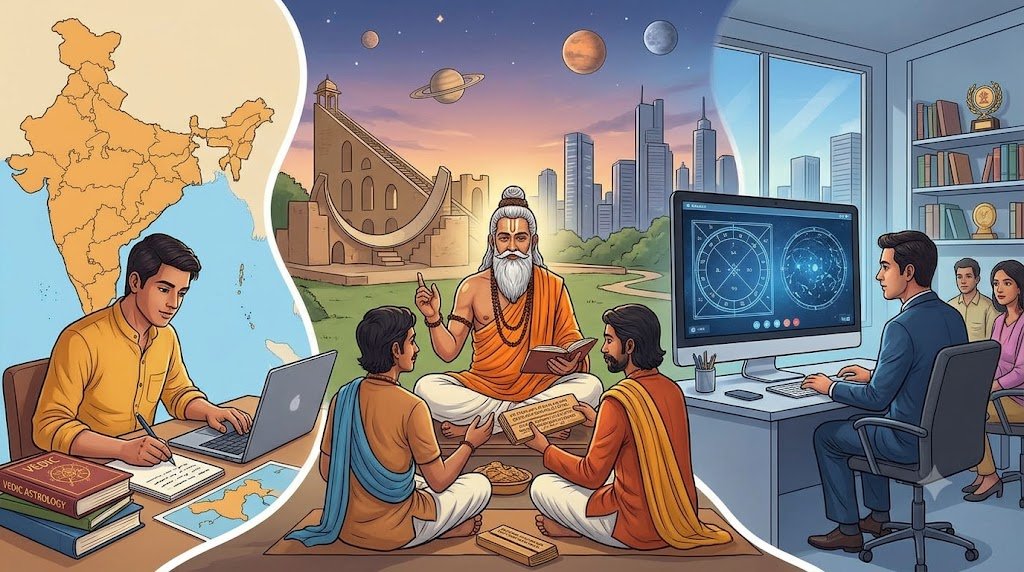
Are you passionate about Vedic astrology, Kundli reading, planetary movements and ancient Indian traditions? If you are wondering how to become a professional astrologer in India, this comprehensive 2026 guide will help you understand the educational pathways, essential skills, astrology courses, certification options and opportunities to build a professional practice.
Astrology, traditionally known as Jyotish Shastra in India, has been studied and practised for centuries as part of Indian cultural and philosophical traditions.
Today, students can explore astrology through traditional teachers, online classes, independent institutes and selected university programmes. Digital platforms have also made it easier for aspiring practitioners to learn from home and connect with people interested in astrological consultations.
For individuals searching for the best online astrology courses in India, Divine Number Healing offers educational guidance in astrology, numerology and Vastu.
But becoming a professional astrologer involves more than memorising zodiac signs or learning to read a birth chart. It requires structured learning, repeated practice, communication skills, professional ethics and an understanding of the responsibilities involved in advising others.
In this complete guide, we explore the steps to learn astrology, the different educational options in India, the skills commonly used in Jyotish practice, possible earning models and how Divine Number Healing can support your learning journey.
1. What Is Astrology and Why Do People Study It?
Astrology is a traditional interpretive system that assigns meaning to the positions and movements of celestial bodies.
In India, Vedic astrology or Jyotish is closely connected with longstanding traditions involving calendars, planetary calculations, horoscopes and symbolic interpretations.
People study astrology for several reasons, including cultural interest, spiritual exploration, personal reflection, family traditions and the possibility of offering consultations or educational services.
Major branches of astrology
-
Vedic Astrology (Jyotish): Traditional Indian approaches to interpreting planetary positions and birth charts.
-
Natal Astrology: Interpretation of an individual’s horoscope or birth chart.
-
Muhurta: Traditional selection of auspicious times for certain activities.
-
Prashna Astrology: Interpretations associated with a question and its timing.
-
Numerology: Symbolic interpretations assigned to numbers, names and dates.
-
Western Astrology: Approaches involving zodiac signs, planetary aspects and horoscope interpretations.
Although astrology has substantial cultural and historical significance, it is important to distinguish it from astronomy. Astronomy is an evidence-based science, while astrology’s claims about predicting personality and future events have not been established scientifically.
Aspiring practitioners should approach astrology as a traditional interpretive practice, without promising scientifically proven predictions or guaranteed outcomes.
2. How to Become a Professional Astrologer in India – Step-by-Step Guide
There is no single educational pathway that every aspiring astrologer must follow.
Some practitioners study with traditional teachers, while others choose private training programmes or university-based Jyotish education.
The following steps provide a practical learning roadmap.
Step 1: Understand the fundamentals of Vedic astrology
Beginners should first learn the basic concepts used in traditional Indian astrology.
Important topics include:
-
The 12 zodiac signs or Rashis
-
The nine Grahas used in Jyotish interpretation
-
The 12 astrological houses or Bhavas
-
The 27 Nakshatras
-
Planetary aspects and relationships
-
Ascendant or Lagna
-
Horoscope structure
-
Traditional planetary periods or Dashas
Building a clear understanding of terminology and chart structure provides a foundation for advanced learning.
Step 2: Join a structured astrology course
A structured course can help beginners study concepts in a logical sequence.
Look for programmes that offer a clear syllabus, experienced instructors, guided practice and opportunities to ask questions.
Divine Number Healing offers astrology-related education alongside numerology and Vastu learning.
According to its official website, the platform was founded by Subhass Ch. Bhattacharya and Mitali P. Kurmi and describes more than 14 years of teaching and study experience.
Step 3: Learn to read and interpret Kundli charts
Kundli reading is an important component of traditional Vedic astrology.
Students generally learn how to identify planetary placements, examine houses and interpret relationships between chart elements according to the system being studied.
Practical learning may involve studying sample charts and discussing different traditional interpretations under an instructor’s guidance.
Step 4: Practise with guidance
Consistent practice is essential for learning the terminology, calculations and interpretive methods of astrology.
Beginners can work with fictional examples, instructor-provided charts or charts shared with informed consent.
Maintain a learning journal to record techniques, questions and feedback.
Step 5: Develop consultation skills
Professional astrology consultations involve direct interaction with people, so communication and listening skills are important.
Practitioners should learn how to explain traditional interpretations clearly while acknowledging uncertainty and respecting clients’ beliefs and choices.
Step 6: Learn ethical professional practice
An astrologer should never use fear, emotional pressure or claims of guaranteed results to sell services.
Important principles include client confidentiality, transparent pricing, respectful communication and appropriate professional boundaries.
Step 7: Build a responsible professional presence
Once adequately trained, aspiring practitioners can explore offering educational sessions, workshops or traditional astrology consultations.
A professional website, clear service descriptions, transparent booking terms and educational content can help potential clients understand what is being offered.
3. Educational Qualifications Required to Become an Astrologer in India
One common question is whether a particular degree is compulsory to become a professional astrologer.
India does not have a single universal government licensing qualification for all practitioners offering traditional astrology consultations.
However, the eligibility and recognition of educational programmes are separate matters. A private course completion certificate should not be represented as a government-recognised degree unless that status is verified.
Common learning pathways
| Learning pathway | Suitable for | Qualification considerations |
|---|---|---|
| Beginner astrology course | New learners | Usually a private training certificate |
| Advanced Jyotish programme | Learners with prior knowledge | Requirements vary by provider |
| University Jyotish degree | Eligible graduates | Verify university and programme recognition |
| Traditional mentorship | Students seeking individual guidance | May not award a formal academic credential |
| Specialised workshops | Existing practitioners | Often continuing education rather than a degree |
University-level astrology education
Some Indian universities offer formal programmes in Jyotish or Jyotirvigyan.
For example, Indira Gandhi National Open University (IGNOU) lists an M.A. in Jyotish through open and distance learning.
Official course information: IGNOU – M.A. in Jyotish.
Chhatrapati Shahu Ji Maharaj University also lists a two-year M.A. in Jyotirvigyan for eligible graduates.
Official course information: CSJMU – M.A. in Jyotirvigyan.
Students considering university qualifications should check the latest admission calendar, course eligibility, delivery mode and university recognition.
For distance and online degree programmes, recognition can be checked through the University Grants Commission Distance Education Bureau.
4. Best Astrology Courses for Beginners in India
Students interested in astrology education can explore several types of courses.
Beginner Vedic Astrology Course
A foundation-level course commonly introduces zodiac signs, planets, houses, Nakshatras and basic horoscope interpretation.
It is suitable for people starting with little or no prior knowledge.
Advanced Vedic Astrology Course
Advanced learning may cover divisional charts, planetary periods, transit interpretation and more complex traditional methods.
Students should ideally complete foundational training before moving to advanced topics.
Kundli Reading Course
This type of training focuses on understanding horoscope structures and traditional methods of chart interpretation.
Numerology Course
Numerology explores symbolic number systems and their traditional interpretations.
Students interested in name numerology, life path numbers or date-of-birth calculations may choose a specialised numerology programme.
Vastu Shastra Course
Vastu education introduces traditional Indian concepts concerning buildings, orientation, spatial arrangement and design.
These traditions should not be confused with scientifically established architectural, engineering or health principles.
Astrology Teaching and Professional Development
Experienced learners may explore teaching, writing, workshops and educational content creation.
Before joining any private course, verify the curriculum, instructor background, fees, refund policy and the exact nature of any certificate.
5. What Skills Should a Professional Astrologer Develop?
Learning traditional astrology concepts is only one part of developing a professional practice.
Chart interpretation
Students should understand the interpretive system they are using and apply it consistently.
Basic mathematics and astronomical literacy
Traditional chart preparation involves time, location, calendars and planetary-position calculations.
Understanding how astronomical data is calculated can help learners distinguish factual celestial positions from astrological interpretations.
Communication skills
Clear explanations help clients understand the nature and limitations of the service.
Listening skills
A consultation should involve respectful listening and an understanding of the client’s stated questions.
Analytical organisation
Maintaining organised notes can help practitioners explain the interpretive steps used in a reading.
Professional ethics
Good practice includes protecting client information, avoiding unfounded promises and refusing to exploit anxiety or vulnerability.
Digital skills
Website management, online scheduling, digital payments and educational content creation can be useful for independent practitioners.
6. How Long Does It Take to Learn Astrology?
The time needed to study astrology depends on the learner’s goals, prior knowledge, course structure and available study time.
There is no universally recognised timetable for becoming professionally competent.
The following is an illustrative self-study roadmap, not a guaranteed training or certification schedule.
| Learning stage | Suggested study period | Main focus |
|---|---|---|
| Foundation | Months 1–2 | Signs, planets, houses and basic terminology |
| Intermediate | Months 3–4 | Chart structure and traditional interpretation |
| Applied learning | Months 5–6 | Guided chart exercises and case discussions |
| Advanced development | Months 7–9 | Specialised traditional techniques |
| Professional preparation | Months 10–12 | Communication, ethics and supervised practice |
Learners may need considerably longer to develop confidence and competence. University programmes have their own prescribed academic durations.
7. Astrology Certification Courses in India – Are Certificates Important?
Certificates may help demonstrate that a student has completed a particular course, but their value depends on the issuing organisation.
Private astrology training certificates are not automatically equivalent to university degrees or government licences.
For example, the Indian Council of Astrological Sciences (ICAS) offers courses such as Jyotish Praveena and Jyotish Visharada.
ICAS explicitly states that it is an independent professional organisation and that its courses are not presently affiliated with a university or government organisation.
When evaluating an astrology certification course, ask:
-
Who issues the certificate?
-
Is the qualification academic or privately awarded?
-
What subjects does the course cover?
-
Are assessments required?
-
Does the programme include guided practical exercises?
-
Is any claimed university or government recognition verifiable?
The University Grants Commission explains that universities may offer diploma and certificate programmes under applicable approval requirements, but private providers should not imply UGC recognition without a valid basis.
8. Career Opportunities After Learning Astrology in India
Individuals who study astrology may choose to continue as hobbyists, pursue additional education or explore independent professional activities.
There are several possible paths, although paid opportunities are not guaranteed.
Independent Astrology Consultant
Practitioners may offer traditional horoscope interpretation sessions to clients interested in astrology.
Services should have transparent fees, clear descriptions and appropriate disclaimers.
Online Astrology Educator
Experienced learners with suitable teaching abilities may create educational courses, workshops and live classes.
Numerology Practitioner
Those interested in number-based traditions may study numerology and offer educational or interpretive sessions.
Astrology Blogger or Content Creator
Students with writing or communication skills can create articles, videos and other educational resources explaining traditional concepts.
Astrology Course Instructor
After gaining relevant subject knowledge and teaching experience, individuals may explore teaching beginner-level subjects.
Astrology and Vastu Learning Entrepreneur
Some professionals establish educational websites offering classes, workshops and related learning resources.
Digital Education and Publishing
Other opportunities include course material development, translation, editing, educational media production and digital community management.
Career success depends on skill, trust, communication, business operations and the ability to provide a responsible service.
9. How Much Can a Professional Astrologer Earn in India in 2026?
Astrology does not have a standard national salary structure for independent practitioners.
Income can vary significantly depending on experience, reputation, service format, client enquiries, pricing and operating expenses.
Instead of relying on unverified salary claims, it is useful to understand how a consultation-based business model works.
Illustrative consultation revenue model
| Example consultations | Example fee | Gross revenue |
|---|---|---|
| 10 consultations/month | ₹500 each | ₹5,000 |
| 25 consultations/month | ₹800 each | ₹20,000 |
| 40 consultations/month | ₹1,000 each | ₹40,000 |
| 60 consultations/month | ₹1,500 each | ₹90,000 |
These are hypothetical calculations, not verified 2026 average earnings or projections for Divine Number Healing students.
Actual profit may be much lower after marketing costs, platform fees, payment processing, taxes and business expenses. Practitioners should never assume a certain number of clients or guaranteed monthly income.
For beginners, developing genuine knowledge, transparent business practices and client trust is more important than making unrealistic income promises.
10. Can You Learn Astrology Online from Home?
Yes. Astrology can be studied through books, recorded lessons, live online classes and instructor-guided educational programmes.
Online learning can be convenient for working professionals, students, homemakers and people who cannot attend regular physical classes.
Benefits of structured online learning
Flexible learning environment: Students may be able to study alongside existing commitments.
Access to specialised instructors: Online education can connect learners with teachers outside their city.
Organised syllabus: A properly designed course introduces foundational topics before advanced techniques.
Guided practice: Exercises and instructor feedback can help students understand traditional chart interpretation.
Opportunities for discussion: Interactive classes may allow learners to ask questions and compare approaches.
However, recorded videos alone may not provide enough practice or feedback for every student.
Before enrolling, check whether a course actually offers live sessions, recorded materials, assignments, mentoring or assessments.
11. Why Explore Astrology Learning with Divine Number Healing?
For those looking for an online astrology learning platform in India, Divine Number Healing offers an opportunity to explore traditional astrology, numerology and Vastu-related subjects.
According to its official website, the platform focuses on combining traditional learning with accessible explanations and guided instruction.
Experienced educators
Divine Number Healing identifies Dr. Subhass Ch. Bhattacharya as an astrologer, numerologist and Vastu expert.
The website describes his engineering background and more than 20 years of professional experience.
It also identifies Mitali P. Kurmi as an educator and co-founder with experience in holistic and traditional practices.
Astrology, Numerology and Vastu Learning
The platform introduces learners to several related traditional disciplines, offering opportunities to explore different subjects according to personal interests.
Beginner-friendly educational approach
Divine Number Healing describes its teaching philosophy as emphasising awareness, logical explanation and practical learning of traditional concepts.
Established teaching experience
The official website reports having guided several groups of astrology students and additional groups studying Vastu and numerology.
These figures are published by the platform itself rather than independently audited outcomes.
Focus on personal learning
Students interested in Jyotish Shastra, numerology or Vastu can explore the programmes and discuss their individual educational objectives before joining.
Explore the official website: Divine Number Healing – Astrology, Numerology and Vastu Courses.
Course fees, schedules, teaching formats, certification arrangements and current enrolment availability should be confirmed directly.
12. Difference Between Astrology, Numerology and Vastu Shastra
Although these traditions are sometimes taught together, their concepts and methods differ.
| Subject | Main area of traditional study | Common learning focus |
|---|---|---|
| Vedic Astrology | Symbolic interpretation of celestial positions | Kundli, Rashis, Grahas, Nakshatras |
| Numerology | Symbolic interpretations of numbers | Number calculations, names and dates |
| Vastu Shastra | Traditional spatial principles | Directions, building layouts and arrangements |
A student interested in horoscope interpretation may begin with Vedic astrology.
Someone interested in symbolic number systems might prefer numerology.
Learners interested in traditional Indian approaches to spaces and buildings may choose Vastu education.
None of these systems should replace qualified medical, mental health, financial, legal or engineering advice.
13. How to Start an Online Astrology Practice in India
Once you have developed appropriate knowledge and communication skills, you may explore establishing an independent practice.
Build a professional website
Create a website that clearly explains your background, the nature of your services, consultation fees, cancellation rules and contact methods.
Offer transparent consultation bookings
If you provide paid sessions, state the duration, price, refund policy and what the consultation involves.
Publish educational blog articles
SEO-friendly articles can help people find your educational content through Google.
Useful topics include understanding a birth chart, the meaning of Nakshatras, introductory Jyotish terminology and how to select an astrology learning course.
Create educational videos
Short explanatory videos can introduce traditional concepts to beginners and direct interested viewers towards longer learning resources.
Protect client information
Birth dates, birth times, contact information and consultation notes can be sensitive personal data. Collect only the information necessary for the service and use appropriate privacy practices.
Follow applicable business requirements
A paid practice may involve taxation, business registration, consumer protection, privacy and advertising obligations depending on how it operates.
In India, the Central Consumer Protection Authority addresses misleading advertisements and unfair trade practices under the Consumer Protection Act framework.
Practitioners should avoid promising guaranteed marriage outcomes, cures, financial success or other results that cannot be substantiated.
14. Mistakes Beginners Should Avoid While Learning Astrology
Learning advanced concepts before the basics
Starting with complicated techniques before understanding foundational terminology can create unnecessary confusion.
Depending entirely on automated horoscope tools
Software can organise astronomical information and traditional calculations, but learners should understand the methods and assumptions behind the interpretations.
Making absolute predictions
Astrological interpretations are not scientifically reliable predictions. Avoid presenting them as certainty.
Ignoring client confidentiality
Never publish someone’s birth details, consultation records or private questions without informed permission.
Making exaggerated professional claims
Do not advertise unverified academic recognition, guaranteed earnings or guaranteed life outcomes.
Choosing courses solely on advertised certification
Evaluate the actual syllabus, instructor credentials, teaching support and qualification status.
Replacing professional advice
Astrology consultations should not be used as substitutes for healthcare, legal services, mental health treatment or financial advice.
15. Frequently Asked Questions About Becoming an Astrologer in India
Q1. How can I become a professional astrologer in India?
Start by studying Vedic astrology fundamentals, enrol in suitable training, practise traditional chart interpretation, develop communication skills and understand your professional responsibilities before offering paid consultations.
Q2. Can I learn astrology after Class 12?
Yes. Many private beginner programmes accept learners from different educational backgrounds. University postgraduate programmes generally require a relevant bachelor’s qualification.
Q3. Is a degree compulsory to become an astrologer?
There is no single compulsory national degree requirement for all traditional astrology consultations in India. However, academic programmes and other regulated business activities have their own requirements.
Q4. Which astrology course is best for beginners?
A foundational Vedic astrology course introducing Rashis, Grahas, Bhavas, Nakshatras and basic Kundli structure is a sensible starting point.
Q5. Can I learn astrology online?
Yes. Students can learn through online instruction, guided courses, books and practical exercises.
Q6. How long does it take to become an astrologer?
There is no universal timeline. Learning duration depends on study intensity, course depth, practice and personal objectives.
Q7. Can astrologers earn money through online consultations?
Some practitioners charge for consultations or educational services, but income varies and no particular earnings are guaranteed.
Q8. Is astrology scientifically proven?
No. Astrology has cultural and historical significance, but scientific research has not established that birth-chart interpretations can reliably predict personality or future events.
Q9. What is the difference between Vedic astrology and numerology?
Vedic astrology traditionally interprets horoscope structures and celestial positions, while numerology assigns symbolic meanings to numbers.
Q10. Where can I explore astrology and numerology learning in India?
Divine Number Healing offers information about astrology, numerology and Vastu learning through its official website, divinenumberhealing.in.
16. Conclusion – Start Your Astrology Learning Journey in 2026
Learning astrology can be a meaningful journey for individuals interested in Indian traditions, symbolic interpretation, cultural history and spiritual exploration.
Whether your goal is to study Vedic astrology as a personal interest, understand Kundli interpretation, learn numerology or explore a responsible professional practice, structured education provides a useful starting point.
Focus on developing foundational knowledge, learning from experienced teachers, practising with care and maintaining honesty about what astrology can and cannot establish.
For learners searching for astrology and numerology education, Divine Number Healing provides a platform to explore these traditional subjects with guidance from its educators.
Take the first step towards understanding Vedic Astrology, Numerology and Vastu with Divine Number Healing.
Visit Divine Number Healing to learn more about available programmes, educators and enrolment enquiries.
Recommended external links for SEO
| Website | Suggested anchor text |
|---|---|
| IGNOU | M.A. in Jyotish at IGNOU |
| CSJMU | University Jyotirvigyan programme |
| University Grants Commission | Check recognised universities in India |
| UGC Distance Education Bureau | Verify online and distance education programmes |
| Indian Council of Astrological Sciences | Traditional astrology education and courses |
| Department of Consumer Affairs | Consumer protection and advertising requirements |
| OpenStax Astronomy | Difference between astrology and astronomy |
